Highlights
- A novel neural circuit mechanism for the cognitive, learning, and motivational functions that enable context-dependent flexible behavior was proposed.
- The occurrence of, and a condition for, double autonomous alignments of connections in a theoretical model of cortico-basal ganglia-midbrain circuit were discovered.
- The results indicate a novel mechanistic link between the suggested neuronal excitation/inhibition imbalance in schizophrenia and its multiple symptoms.
Contents
Understanding the neural mechanisms of behavior by constructing computational models of neural circuits based on theories such as reinforcement learning has become a major approach. However, mechanisms for how appropriate internal representations of the environmental states are acquired, and how context-dependent motivational control is achieved, remain elusive.
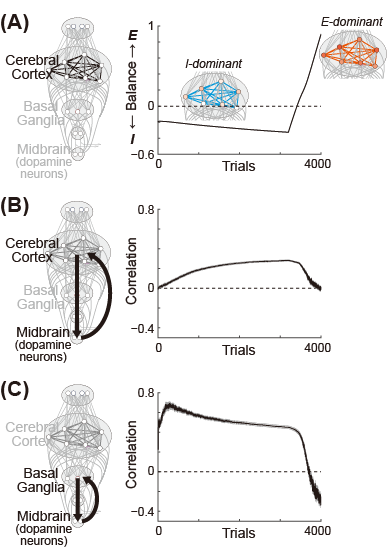
Dr. Kenji Morita (associate professor at the Graduate School of Education and affiliated faculty at the International Research Center for Neurointelligence (WPI-IRCN) of the University of Tokyo, Japan) and Dr. Arvind Kumar (associate professor at the Division of Computational Science and Technology of the KTH Royal Institute of Technology, Sweden) addressed these issues by constructing and analyzing a model of cortico-basal ganglia-midbrain circuit, which combined preceding models constructed by themselves and others. They have then shown that both acquisition of appropriate internal representations of states and context-dependent motivational control can be realized through double autonomous alignments (called the "feedback alignment") of the cortex→(via basal ganglia)→midbrain and basal ganglia→midbrain projections to the (reverse-direction) dopaminergic midbrain→cortex and midbrain→basal ganglia projections, respectively.
Moreover, they found that the cortical excitation/inhibition (E/I) balance is a key for such autonomous alignments (Figure 1). If the balance is shifted towards excessive excitation, the alignments become degraded and one of them become eventually reversed into anti-correlation, impairing context-dependent motivational control and credit assignment for outcome to preceding states. This provides a novel potential mechanistic explanation on how the cortical E/I imbalance, which has been suggested to be a major neural substrate of schizophrenia (among other alterations in the cortico-basal ganglia-midbrain circuits), causes its multiple major symptoms, specifically, negative symptoms characterized by motivational impairments and positive symptoms characterized by delusion and hallucination, which can be considered as impairments in credit assignment.
Future studies are desired to validate these possibilities in more elaborative models and also in experiments. On the other hand, the feedback alignment, which plays the key role in the mechanisms proposed in the present study, was originally proposed as a biologically implementable alternative to the Back-Propagation algorithm, which is centrally used in modern artificial intelligence (AI). Given this, the present study is expected to also contribute to revealing the mechanisms of human/animal "neurointelligence", which should differ from AI.
The University of Tokyo has a strategic partnership with the "Stockholm Trio", which consists of the KTH Royal Institute of Technology (collaborating partner of the present study), Stockholm University, and Karolinska Institute since 2017, and the present study is expected to contribute to its further development.
Corresponding author
Associate Professor at Graduate School of Education,
and affiliated faculty at the International Research Center for Neurointelligence (WPI-IRCN),
The University of Tokyo
Kenji Morita Ph.D.
ORCID iD : orcid.org/0000-0003-2192-4248
Article information
Journal: The Journal of Neuroscience
Title: Mesocorticostriatal reinforcement learning of state representation and value with implications for the mechanisms of schizophrenia
Authors: Kenji Morita and Arvind Kumar
DOI: 10.1523/JNEUROSCI.1762-25.2026
URL: https://doi.org/10.1162/NECO.a.38
Grants
K.M. was supported by Grants-in-Aid for Scientific Research 25H02594 and 23K27985 from Japan Society for the Promotion of Science (JSPS). A.K. acknowledges partial funding from the strategic research area StratNeuro.